Posts
Posts


You may have already seen the first fresh olives in the market. It looks like an early season this year. One of the few crops to survive in our garden apart from the garlic and tomatoes have been the olives. Rather than a bumper crop, due to a spring hail storm it will be a modest olive yield but there is plenty of new growth that holds a promise for next year.
Philipe E Muskett in his 1893 volume The Art of Living in Australia talks about how the [then] newish colony had neglected to embrace the Mediterranean climate in all our early food choices and in that thesis reinforces how important olives are t o a healthy and enjoyable food culture. He also gives us very good advice on fish, wine and use of indigenous game meats in his extraordinarily clear early vision of the future of food in this country. I was given this copy by Dr. John and Margaret Cone on the day Sunnybrae went into recess in 2000 it remains one of my favourite volumes.
I had been using Catalonian Arbequina oil for many years and developed a “cellar palate” for Arbequina. When the time came to select a variety to plant here, by sheer arse we picked a winner. We planted our tiny [100 trees] Arbequina Olive grove about 7 years ago. The trees are small so no ladders are needed, it crops annually [many other varieties are biennial] and the yield is high. But best of all the flavour is superb. The most common myth that many olive oil producers fall prey to: is to pick the olives when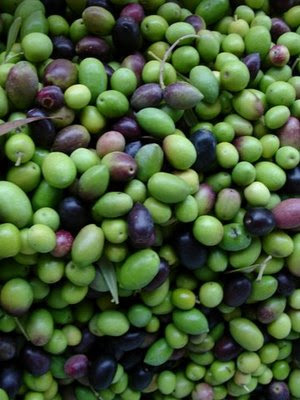 they are fully ripe. We pick when they are just turning from green through red to some black.
But how is olive oil made? It was quite a revelation when we had our first crop processed three years ago.
I thought that all oil was pressed. Indeed some still is, but pressing in the old traditional way has a few drawbacks. Olive oil is free oil in the juice of the olive but it has also some bitter water components that need to be separated as anyone who has tried to eat a fresh olive will never fail to remember.
The early methods were to crush the olives, make a paste, then knead the paste, to bring together the small oil droplets till they “pool.” This is called malaxing, and then to spread the paste onto mats in thin layers inside a press and apply light pressure. As the layers are pressed the fresh oil and bitter water needs to settle for quite a while to let the oil separate from the residues and bitter water.
The problem with this method is that the mats are very difficult to clean between batches and between seasons so some taint can creep in. Also it can take quite some time to load and reload the press resulting in some oxidation of the paste also giving less than perfect results. Also while the oil is settling that extra-ordinary out-of-body mind-b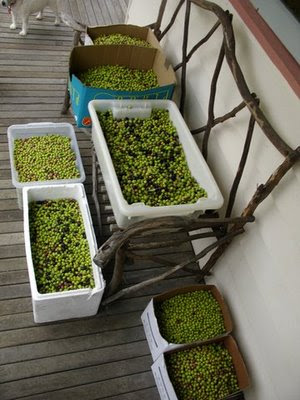 lowing flavours that olive oil growers like to bang on about are lost.
We take our small crop to Camillo Olives in Teesdale link here http://www.camilo.com.au/ about a half an hour from Sunnybrae where they have a state of the art processing facility suited to very small crops. They grow the traditional Ligurian varieties for their own very fine oil.
The first two stages are the same as the old traditional methods in that the olives are washed, t he leave
 s and stalks are separated and then they are crushed in a small hammermill that is cooled
The paste is then passed into another chamber where it is kneaded by a helix shaped paddle until the oil has pooled. The operator needs to understand when optimum malaxing has occurred. This is a fine call as over-malaxing can ruin the batch. With true extra virgin olive oil it’s not about getting the largest yield but the finest.
After malaxing comes the most visually exciting stage, the pooled paste is pumped gently into the next chamber and is spun at high speed. The first thing to escape is the crushed pips that fly out almost instantly as they are the lightest. Then the skilled operator using a small dial waits till the oil starts to emerge, then cranks it up slowly till a little of the bitter water begins to come through with th
 e oil. He then lowers the speed back to when just glorious iridescent green oil starts to flow.
At this point a little bread is dipped and the flavour of this year’s oil is revealed. As with wine we have found each year to be quite different.
The whole process takes less than 2 hours and the oil never tastes better than on that day.
Over the next month the oil settles again and becomes clear but some of the life will have already gone from the oil. It will stay fresh for about 8 months if kept cool in the dark.
Too many producers are afraid to release really fresh oil, some even freeze it from year to year.
Philipe E Muskett in his 1893 volume The Art of Living in Australia talks about how the [then] newish colony had neglected to embrace the Mediterranean climate in all our early food choices and in that thesis reinforces how important olives are t
o a healthy and enjoyable food culture. He also gives us very good advice on fish, wine and use of indigenous game meats in his extraordinarily clear early vision of the future of food in this country. I was given this copy by Dr. John and Margaret Cone on the day Sunnybrae went into recess in 2000 it remains one of my favourite volumes.I had been using Catalonian Arbequina oil for many years and developed a “cellar palate” for Arbequina. When the time came to select a variety to plant here, by sheer arse we picked a winner. We planted our tiny [100 trees] Arbequina Olive grove about 7 years ago. The trees are small so no ladders are needed, it crops annually [many other varieties are biennial] and the yield is high. But best of all the flavour is superb. The most common myth that many olive oil producers fall prey to: is to pick the olives when
they are fully ripe. We pick when they are just turning from green through red to some black.But how is olive oil made? It was quite a revelation when we had our first crop processed three years ago.
I thought that all oil was pressed. Indeed some still is, but pressing in the old traditional way has a few drawbacks. Olive oil is free oil in the juice of the olive but it has also some bitter water components that need to be separated as anyone who has tried to eat a fresh olive will never fail to remember.
The early methods were to crush the olives, make a paste, then knead the paste, to bring together the small oil droplets till they “pool.” This is called malaxing, and then to spread the paste onto mats in thin layers inside a press and apply light pressure. As the layers are pressed the fresh oil and bitter water needs to settle for quite a while to let the oil separate from the residues and bitter water.
The problem with this method is that the mats are very difficult to clean between batches and between seasons so some taint can creep in. Also it can take quite some time to load and reload the press resulting in some oxidation of the paste also giving less than perfect results. Also while the oil is settling that extra-ordinary out-of-body mind-b
lowing flavours that olive oil growers like to bang on about are lost.We take our small crop to Camillo Olives in Teesdale link here http://www.camilo.com.au/ about a half an hour from Sunnybrae where they have a state of the art processing facility suited to very small crops. They grow the traditional Ligurian varieties for their own very fine oil.
The first two stages are the same as the old traditional methods in that the olives are washed, t
he leaves and stalks are separated and then they are crushed in a small hammermill that is cooledThe paste is then passed into another chamber where it is kneaded by a helix shaped paddle until the oil has pooled. The operator needs to understand when optimum malaxing has occurred. This is a fine call as over-malaxing can ruin the batch. With true extra virgin olive oil it’s not about getting the largest yield but the finest.
After malaxing comes the most visually exciting stage, the pooled paste is pumped gently into the next chamber and is spun at high speed. The first thing to escape is the crushed pips that fly out almost
instantly as they are the lightest. Then the skilled operator using a small dial waits till the oil starts to emerge, then cranks it up slowly till a little of the bitter water begins to come through with the oil. He then lowers the speed back to when just glorious iridescent green oil starts to flow.At this point a little bread is dipped and the flavour of this year’s oil is revealed. As with wine we have found each year to be quite different.
The whole process takes less than 2 hours and the oil never tastes better than on that day.
Over the next month the oil settles again and becomes clear but some of the life will have already gone from the oil. It will stay fresh for about 8 months if kept cool in the dark.
Too many producers are afraid to release really fresh oil, some even freeze it from year to year.