
 Posts
Posts


A good mate of mine was going through his late father’s papers and stumbled upon a folder that he thought I might enjoy reading. The modern history of wine as many of you know all too well, was rather rudely interrupted by an American louse that swept through the vineyards of Europe and also made a very unwelcome presence in the vineyards of Australia in the 1870’s.
The history of wine in the Geelong district has always been of interest to us as Diane’s great, great grandfather on her fathers side was an Alwin Seidel with vineyards at Ceres near Geelong. We have often visited the site of the Ceres Nursery and Vineyard, as it was called, to see the only remains, an old cellar. Wine has always been in Diane’s blood [now its mostly .05] with her great grandfather on her mother’s side, a Pierre Guillerme, being head cellarman at St.Huberts the Yarra Valley.
But back to the louse. Phylloxera Vastatrix is a small insect that feeds on and destoys the roots of European grapevines but does not attack American rootstock. The folder contained the sad story in the original government reports of how all the vines in the Geelong area were to be uprooted and destroyed.
The first report from 1878 is a short description of the spread of the insect in the vineyards with brief notes as to their size, location and condition. The second appendix in this report is an update of which ones had been uprooted and destroyed to that date.
The third report from 1880 is the Proceedings Of The Committee. This reads like a stage play with cross examinations of what appears to be rather innocent and uneducated farmers and their first reaction to seeds coming from America that appeared to be resistant to the disease. It makes heart breaking reading as so many of the
 names are still in the district and the place names are ones we travel through every week.
The third report from 1889 is by The Hon. J.W. Tavener, MP., Minister of Agriculture and gives a full report of the spread of the disease in France and how the problem is being addressed in Europe.
The fourth report is the saddest of all from A.R. Wallis who states...Sir- I have the honour to report that the work of eradicating the vineyards of the Geelong district within 3 miles of those that were infected ... have been destroyed.....
And that
"I am of the opinion that arrangements should be made this season to for the eradication of all the vines planted in the parishes of Barrabool, Gheringhap, and Moorpanyal: also in the Valley of the Moorabool river to the south boundary of the parish of Darravil, Germantown and Leigh road."
He goes on to say the rest are safe to leave for one more season when I guess they were all uprooted and would not return for many years.
A familiar name crops up in the first report Charles Louis Tetaz. I came across Tetaz while doing research for the Pettavel Restaurant in 2000. His great grandson John Tetaz produced a book “From Boudry to The Barrabool Hills The Swiss Vignerons of Geelong” that paints a very vivid picture of life in the wine trade in the 1860’s and 70’s. Sunnybrae was built in 1868 and readi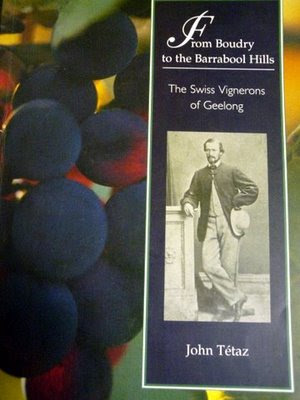 ng his book brings us a little closer to understanding what life was like for these early pioneers.
It will take a bit of time to carefully read all the reports but I am looking forward to returning to an older time while drinking the very excellent new wines of the area. Time for a Prince Albert pinot....
And that
"I am of the opinion that arrangements should be made this season to for the eradication of all the vines planted in the parishes of Barrabool, Gheringhap, and Moorpanyal: also in the Valley of the Moorabool river to the south boundary of the parish of Darravil, Germantown and Leigh road."
He goes on to say the rest are safe to leave for one more season when I guess they were all uprooted and would not return for many years.
A familiar name crops up in the first report Charles Louis Tetaz. I came across Tetaz while doing research for the Pettavel Restaurant in 2000. His great grandson John Tetaz produced a book “From Boudry to The Barrabool Hills The Swiss Vignerons of Geelong” that paints a very vivid picture of life in the wine trade in the 1860’s and 70’s. Sunnybrae was built in 1868 and readi
 ng his book brings us a little closer to understanding what life was like for these early pioneers.
It will take a bit of time to carefully read all the reports but I am looking forward to returning to an older time while drinking the very excellent new wines of the area. Time for a Prince Albert pinot....


